

The Gathering at Garst: Where History Comes to Life

A summer journey through living history, traditional skills, and the people who keep the past within reach.
There is a particular pleasure in visiting a place where, for a little while, the modern world seems to loosen its grip. The sounds change. The pace changes. Familiar conveniences give way to tools, materials, and practices that once formed the fabric of everyday life. Instead of reading about the past or examining objects behind glass, we find ourselves standing among people who have made it their business to understand how earlier generations lived.
That is part of what makes the Gathering at Garst such an interesting experience.
For a few days, history becomes something we can walk through, listen to, ask questions about, and experience with our own senses.
And perhaps most importantly, it becomes something we can share.
More Than a Historical Reenactment
When we think of historical reenactments, our imaginations often turn immediately toward soldiers, uniforms, battles, and the great events that fill the pages of history books.
But history is also made up of ordinary days.
People grew food, prepared meals, tended gardens, cared for their families, made clothing, repaired tools, practiced trades, gathered medicinal plants, and developed the skills necessary to sustain their households and communities.
Those activities rarely receive the attention given to famous events and historical figures, yet they tell us an enormous amount about how people actually lived.
At the Gathering at Garst, it is this everyday history that I find particularly compelling.
The encampments, demonstrations, conversations, and material culture invite us to consider not simply what happened in the past, but how people went about the business of living.
How was something made? Where did the materials come from? What knowledge did a person need to perform a particular task? How were those skills learned and passed along?
And perhaps most interestingly, which of those skills still have something to offer us today?
The Knowledge in Our Hands
One of the remarkable things about traditional crafts and practical skills is how much knowledge they contain. A finished object may appear simple enough. A basket, a piece of cloth, a wooden utensil, a prepared hide, or a useful household tool might be something we scarcely notice in our everyday lives.
But making that object is another matter entirely.
There are materials to understand, techniques to master, and decisions that experience teaches us to make almost without thinking. The same is true of gardening, preserving food, working with beeswax, tending animals, and preparing medicinal plants.
Much of this knowledge was once passed directly from one person to another. Children learned by watching adults. Apprentices worked alongside experienced craftspeople. Families and communities shared skills because those skills were useful.
Books could preserve instructions, but they could not always communicate the feeling of a tool in the hand, the scent of a plant ready for harvest, or the subtle changes that tell an experienced person when something is finished.
That kind of understanding comes from doing.
And it is one of the reasons living-history gatherings matter.
They give people an opportunity to encounter knowledge that might otherwise remain confined to books, collections, or the memories of those who still practice it.
The People Who Keep History Alive
Of course, none of this happens by accident.
Behind every historical encampment, demonstration, and carefully assembled collection of tools is someone who has devoted time to learning.
Sometimes an extraordinary amount of time.
There is research involved, certainly. But there is also practice, experimentation, craftsmanship, and a willingness to share what has been learned with others.
The people who participate in living-history events are doing more than wearing historical clothing or recreating a particular setting. At their best, they are helping us understand the experiences, skills, and perspectives of people whose lives were very different from our own.
And the conversations can be as valuable as the demonstrations themselves.
A question about an unfamiliar tool can lead to a discussion of an entire trade. A conversation about cooking can reveal how people preserved food through winter. An inquiry about a medicinal plant can open the door to centuries of botanical knowledge.
That is where history becomes especially engaging.
It stops being a collection of dates and begins to feel like a conversation between generations.
A Familiar Connection to the Garden and Apothecary
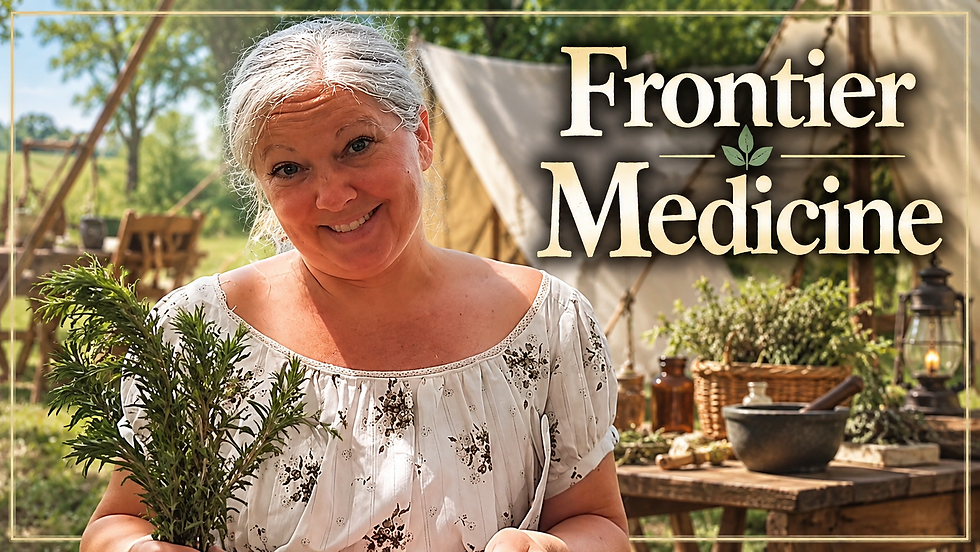
As a gardener and herbalist, I naturally find myself drawn toward the places where historical life intersects with plants. And those intersections are everywhere.
Plants provided food and medicine, of course, but also fibers, dyes, fragrances, oils, fuel, and materials for countless household and practical uses. They were part of the agricultural calendar, the kitchen, the workshop, and the home apothecary.
Understanding plants was not always a specialized pursuit. For many people, it was simply part of understanding the world around them.
At the Gathering, I had an opportunity to explore some of this history with a camp midwife as we searched the encampment for the kinds of ordinary objects and materials she might have used.
It was a delightful reminder that historical healthcare was as much about practical knowledge and resourcefulness as it was about any particular preparation.
A familiar household object could become an important tool. A plant growing nearby could have a place in a traditional remedy. And experience could transform ordinary materials into something genuinely useful. Those ideas remain central to the way I approach herbalism today.
We have the benefit of modern knowledge and methods, but we can still learn from the generations who understood how to grow, gather, prepare, and use the resources around them.
There is no reason those traditions must remain in the past.
History Is Not a Finished Story
One of the things I appreciate about living history is that it reminds us the past was never as simple as it sometimes appears in retrospect. The people who lived before us came from different backgrounds, carried different traditions, and possessed different kinds of knowledge.
In North America, European traditions encountered the long-established agricultural, botanical, and healing knowledge of Indigenous peoples. African traditions and the experiences of successive generations of immigrants also contributed to the development of the communities, crafts, foods, and practices we recognize today. These encounters were complex, and their histories deserve thoughtful attention.
But they also remind us that culture is never entirely static.
Knowledge moves between people and generations. Skills are adapted to new places and circumstances. Familiar practices change as new materials, ideas, and experiences become available.
The past was full of people learning, experimenting, adapting, and trying to make a life with what they knew. In that respect, perhaps we are not so different.
Why We Made the Film
When we began documenting the Gathering at Garst, I wanted to capture more than a collection of demonstrations or a record of an interesting event. I wanted to preserve something of the experience itself.
The atmosphere of the encampment. The details of the clothing, tools, and surroundings. The conversations. The craftsmanship. The moments when someone pauses to explain something they have spent years learning.
And above all, the people.
Because ultimately, they are what make an event like this worth experiencing.
A historical object can survive for centuries. A technique can be recorded in a book. But the enthusiasm of someone who understands a craft and wants to share it is something that must be experienced. That enthusiasm is contagious. It encourages curiosity. It invites questions. And sometimes it sends us home wanting to learn a little more—or perhaps even try something ourselves.
For Verdigris, that is very much in keeping with what we hope to accomplish through our own work. Whether we're exploring medicinal plants, tending the garden, working with the bees, preparing something in the apothecary, or documenting a regional event, the underlying interest is much the same.
How do we keep useful knowledge alive, and how do we make it meaningful to people today?
Carrying the Past Forward
There is a tendency to think of history as something behind us.
Something finished.
Something to be preserved carefully, perhaps admired occasionally, and then returned to its place on a shelf.
But traditions don't remain alive simply because we remember that they existed.
They remain alive because people continue to practice them, study them, teach them, and find new reasons to value them. A gardener saving seeds is participating in a tradition that stretches back thousands of years. An herbalist preparing plants for the home apothecary is drawing upon generations of botanical knowledge. A craftsperson learning an old technique is helping preserve something that might otherwise disappear. And someone who takes the time to share those skills with another person is ensuring that the story continues.
That is what I carried away from the Gathering at Garst.
Not a desire to return to another century, but a renewed appreciation for the knowledge, ingenuity, and craftsmanship that have traveled through the centuries to reach us.
The past doesn't have to be recreated in its entirety to have value in the present.
Sometimes all we need to do is remain curious enough to listen.
And perhaps learn to do something with our own hands.
Watch: The Gathering at Garst
Our short film, The Gathering at Garst, is an invitation to experience a little of this remarkable gathering for yourself.
Through the people, sights, sounds, and traditions of the encampment, we hope to share not only a glimpse of history, but also an appreciation for those who devote themselves to keeping it alive.
Produced by Verdigris Market Garden / Abundance Media, LLC

Comments