

What Did a Home Apothecary Look Like Before the Pharmacy?
There is something remarkable about considering how much of everyday healthcare once began at home.
Before pharmacies became fixtures of nearly every town, people relied heavily on knowledge that lived much closer to them—in kitchens and gardens, in fields and forests, and in the accumulated experience passed among families and communities.
Herbs might hang drying from rafters. Roots and seeds could be stored for the months ahead. Preparations were made when plants were abundant so they would be available when the seasons changed.
And somewhere within a household might be the collection of jars, bottles, dried plants, oils, cloths, tools, and ingredients that formed a working home apothecary.
It probably wouldn't have looked much like the romantic rows of amber bottles we associate with an apothecary today.
It was more practical than that.
It was made from what people had—and what they knew.
Medicine Was Often Close at Hand
For generations, knowing the plants growing around you was part of knowing how to care for a household.
Some useful plants were deliberately cultivated near the home. Others grew along paths, at the edges of fields, in meadows, or in the woods beyond them. Still others arrived through trade and gradually became familiar additions to household practice.
Mint might become a tea. Yarrow had a long association with first aid. Willow was traditionally used for discomfort and fever. Horehound became familiar in preparations for coughs. Elder, mullein, plantain, comfrey, and many other plants found places within different healing traditions.
But the story of herbalism in early America becomes especially interesting when we look at what happened as different traditions encountered one another.
European settlers arrived carrying centuries of European herbal knowledge. Familiar plants such as chamomile, sage, thyme, rosemary, and horehound were part of those traditions, and settlers brought plants with them when they could.
But they were also entering a landscape filled with plants they did not know.
Native American healers already possessed generations of accumulated knowledge about the plants of North America: where they grew, when they should be gathered, which parts were useful, how they could be prepared, and how they fit within much broader traditions of health and healing.
As Europeans encountered Indigenous peoples and became more familiar with the North American landscape, knowledge began to move between these traditions. European herbal practices adapted to unfamiliar plants, while knowledge shared by Native American healers introduced newcomers to plants and preparations that would eventually become familiar within American herbal practice.
Other traditions became part of this developing herbal landscape as well. Africans brought extensive knowledge of plants, foods, and healing traditions across the Atlantic, including knowledge carried under the horrific circumstances of enslavement. Later generations of immigrants brought still more plants, preparations, and practices from their own cultures.
What developed over time wasn't simply European herbalism transplanted onto American soil. It became a complicated melding of knowledge: European herbal traditions encountering Native American healing practices and an unfamiliar botanical landscape, alongside African and other cultural traditions that continued to shape how plants were understood and used.
That exchange wasn't always simple or equitable. Some knowledge was freely shared through relationships between people and communities; other knowledge was adopted without recognition of the people or traditions from which it came.
The result was an evolving American herbal tradition shaped both by the people who arrived here and, importantly, by the people who already knew this land and its plants.
For someone maintaining a home apothecary, much of that accumulated knowledge ultimately became intensely practical:
What grows here? What can I cultivate? What can I preserve? And what have the people who know these plants learned about how to use them?
That makes historical herbalism particularly interesting to me because it was so deeply connected to place.
People learned to work with what was around them.
The Garden Was Part of the Apothecary
The distinction we make today between a culinary herb and a medicinal herb would not always have been particularly useful.
The same plant could have several roles.
Sage could season food and find its way into household preparations. Thyme belonged in the kitchen but also had a long history of traditional use. Garlic was food, a useful plant for household wellness, and something that could be stored through the colder months.
Mint, fennel, rosemary, lavender, chamomile, and countless other plants occupied similarly flexible territory.
They didn't necessarily need to be labeled as either food or medicine.
They were useful plants.
I think there is something worth rediscovering in that idea.
Herbalism doesn't have to exist separately from ordinary life. It can be something that grows beside the kitchen door, flavors dinner, fills the teapot, scents the house, feeds a pollinator, and finds its way into the home apothecary.
The garden and the apothecary don't have to be separate places.
One can quite literally grow out of the other.
An Apothecary Was Also a Set of Skills
Having access to useful plants was only the beginning.
You also had to know what to do with them.
When should a plant be harvested?
Which part should be gathered?
Should it be used fresh or dried?
Would it be steeped in water, simmered, infused into oil or fat, preserved in alcohol, made into a poultice, combined with honey, or simply prepared as food?
And if the plant was needed months after the harvest, how should it be preserved?
These were practical skills.
A household that gathered herbs during the growing season needed to understand drying and storage. Someone preparing roots needed to know that they behaved differently from delicate leaves and flowers. A preparation intended for the skin required different thinking from something intended for the teapot.
This is one of the things I particularly enjoy about traditional herbalism.
An apothecary isn't really defined by how many jars are sitting on its shelves.
It is defined by the knowledge behind them.
That remains true today.
The Community Was Part of the Apothecary
Of course, no individual knew everything.
Knowledge lived within communities.
There were people particularly skilled with plants, others experienced in caring for the sick or injured, and people whose knowledge had been developed through years of attending births and caring for mothers and families.
The midwife is a wonderful example.
Her knowledge could extend well beyond the moment of childbirth. She needed to understand the body, recognize what she was observing, know the resources available to her, and improvise when circumstances required it.
And many of her tools wouldn't necessarily have looked like medical equipment.
A basin was still a basin. Cloth was still cloth. A kettle belonged beside the fire. Spoons, knives, bottles, needles, thread, water, alcohol, fats, herbs, and other ordinary materials could all become useful in the hands of someone who knew what to do with them.
That distinction fascinates me.
The object itself may have been ordinary. The knowledge that transformed it into a useful tool was not.
Knowledge Changes, but the Principle Remains
Today we have opportunities to study plants from perspectives that previous generations didn't have available to them. We can explore their chemistry and physiology while also preserving centuries of observation, experience, and traditional use.
That doesn't make the older relationship with plants irrelevant.
Quite the opposite.
It gives us an opportunity to carry traditional knowledge forward while continuing to deepen our understanding of the plants themselves.
There is value in knowing what grows around us.
There is value in understanding how to prepare a plant rather than knowing it only as an ingredient printed on the front of a bottle.
There is value in learning when plants are ready to harvest, how to preserve them, and how different preparations draw different constituents and qualities from them.
And there is value in maintaining some responsibility for our own everyday wellness rather than becoming completely disconnected from the plants, foods, and practices that have supported human beings for generations.
We don't need to live exactly as our ancestors did to retain that relationship.
We can take what generations of herbalists, healers, gardeners, midwives, cooks, and ordinary households learned about plants and continue the conversation.
What Is Worth Bringing Forward?
Quite a lot, I think.
Perhaps most importantly, the understanding that medicinal plants are not simply historical curiosities or pleasant additions to a cup of tea. They remain useful tools for supporting health and addressing many of the ordinary conditions and imbalances we encounter throughout our lives.
Herbal medicine can complement conventional Western medicine. It can provide supportive care alongside other treatments. And, in the right circumstances, an herbal approach may sometimes be a reasonable alternative to reaching immediately for a pharmaceutical one.
That doesn't mean herbs and pharmaceuticals are interchangeable, or that every condition belongs in the home apothecary. It means we have more than one set of tools available to us—and knowing how and when to use them gives us choices.
A headache doesn't automatically tell us what caused it or what approach it needs. Neither does an unsettled stomach, difficulty sleeping, seasonal discomfort, a minor skin irritation, or the aches that follow a day spent working in the garden.
Herbalism asks us to pay attention to the pattern, the person, and the circumstances before deciding what kind of support makes sense.
That is very different from simply substituting an herb for a pill.
It is also one of the things worth carrying forward from traditional herbal practice:
the ability to participate actively in our own care.
That might mean knowing how to prepare a strong medicinal infusion rather than simply making a pleasant cup of tea. It might mean understanding when a tincture is the more useful preparation, keeping an infused oil or salve available for topical care, or learning which plants in the garden can become meaningful additions to the home apothecary.
It also means learning enough about those plants to use them well.
What are their actions? Which preparation best suits the purpose? How much is appropriate? Are there medications or circumstances that make a particular herb a poor choice? When is something within the realm of reasonable home care, and when does it require another kind of help?
Those aren't reasons to be afraid of herbal medicine.
They are part of knowing herbal medicine.
And this is why I encourage people beginning in herbalism not to worry about learning hundreds of herbs.
Start with a few.
Grow them if you can. Taste them. Learn how they smell when they're fresh and how they change when they're dried. Learn their actions and traditional uses. Make preparations with them. Understand their cautions. Pay attention to how you experience them and how they behave in different circumstances.
Over time, those plants stop being names memorized from a book or ingredients printed on a supplement bottle.
They become tools you understand.
And that, ultimately, is what I think is most worth bringing forward: not simply a collection of old remedies, but the knowledge and confidence to make medicinal plants a practical part of caring for ourselves and the people around us.
A Modern Home Apothecary
A modern home apothecary isn't simply a collection of interesting herbs or a nostalgic recreation of something our ancestors once kept.
It can be a practical part of how we care for our health.
Much of healthcare happens long before we enter a doctor's office. It happens in what we eat, how we sleep, how we move, how we respond to stress, and in the everyday choices we make to support the body's normal functions.
Medicinal plants can be an important part of that care.
For many ordinary health concerns, a knowledgeable person may reasonably choose an herbal preparation as a first approach. In other circumstances, herbs can work alongside conventional treatment. And sometimes the appropriate tool is conventional medicine itself.
The point isn't to declare one system superior to another.
The point is to have more tools—and enough knowledge to choose among them intelligently.
That is what I want a modern home apothecary to represent.
There might be dried medicinal herbs for infusions and decoctions. Tinctures for preparations better suited to alcohol extraction. Infused oils, salves, syrups, honey, vinegars, compresses, and other preparations. There may be culinary herbs and medicinal plants growing just outside the door, ready to be harvested and preserved when the season is right.
But the most important part of the apothecary is still knowledge.
Know the plants you keep.
Know their actions and affinities. Understand why you might choose one herb rather than another. Know how preparation changes what we extract from a plant. Understand reasonable amounts and appropriate use. Know important contraindications and interactions. And learn to recognize the circumstances in which the home apothecary is no longer the appropriate place to manage the situation.
That isn't timidity about herbal medicine.
That is competent herbalism.
And competency doesn't require owning hundreds of herbs.
A well-built home apothecary can begin with a relatively small group of plants that you know deeply and use confidently. Over time, you can add plants and preparations as your knowledge grows and your needs change.
Eventually, the jars on the shelf represent something much more important than ingredients.
They represent plants you recognize. Preparations you know how to make. Gardens you've tended. Harvests you've gathered. Experiences you've accumulated. And choices you are capable of making about your own health.
The goal of the home apothecary isn't simply to own natural remedies. It is to reclaim some of the knowledge and practical ability to care for ourselves.
That is not a relic of the past.
It is a skill worth carrying into the future.
Looking for Medicine at the Gathering at Garst
This summer, I had the opportunity to explore some of these ideas in a particularly enjoyable way at the Gathering at Garst.
Instead of standing in front of a table filled with modern herbal preparations, I joined a camp midwife for a scavenger hunt through the historical encampment.
We went looking for the kinds of ordinary objects and materials a midwife might have found useful and talked about how they could have been employed. Along the way, our conversation naturally turned toward herbs and the plant knowledge that would have accompanied those practical skills.
It was a wonderful exercise because it changed the question.
Instead of asking:
What medicine would I buy for this?
We were asking:
What is around me, what do I know, and how might I use it?
That is a very old way of thinking.
But it is also at the heart of much of what I believe herbalism can still be.
Our gardens are full of useful plants. Our kitchens contain herbs and spices with long histories of traditional use. We can preserve a harvest for winter, make preparations from plants we've grown, and learn enough about the natural world around us to become more capable and more connected to it.
The home apothecary doesn't have to be a relic of the past.
It is a living tradition.
Sometimes medicine grew outside the door.
Sometimes it hung drying in the kitchen.
Sometimes it was stored in a jar for the winter ahead.
And sometimes the most valuable thing in the apothecary wasn't something that could be put into a bottle at all.
It was knowing what to do with what you had.
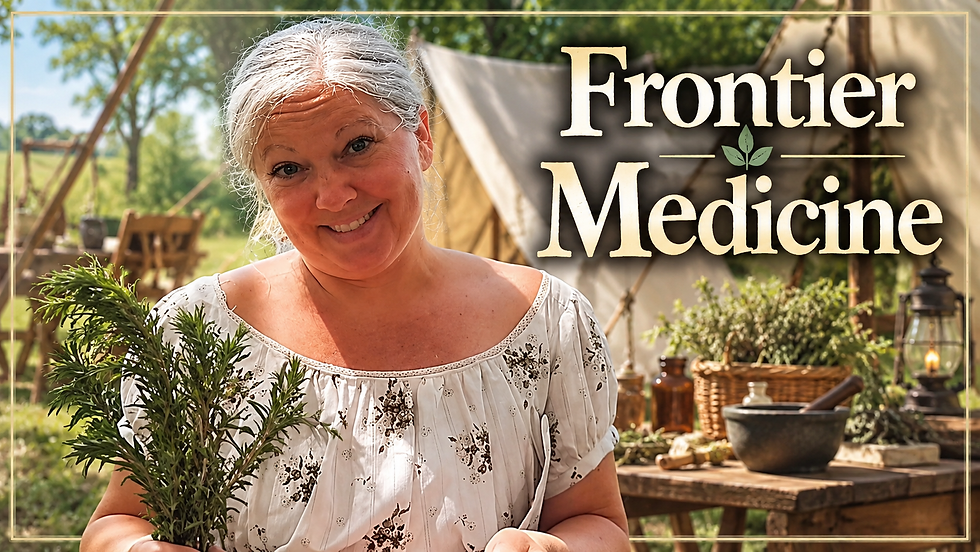
Our Frontier Medicine video from the Gathering at Garst explores this history in a much more hands-on way. Join me and a camp midwife as we search the encampment for the tools she might have used and talk about the herbs and knowledge that accompanied them.
This article is intended for educational purposes only and is not intended to diagnose, treat, cure, or prevent disease. Historical and traditional uses of plants are discussed for educational purposes. Herbs and herbal preparations may not be appropriate for everyone. Seek appropriate professional care when needed.

Comments